Cheque is the most common way used for bank payments or to exchange funds between two peoples. It has flexibility in making payments to someone at a future date.
Writing a Cheque will be easy as long as you know what goes there. In this article we will be discussing 5 points which you have to keep in mind while writing a Cheque.
Name of the payee – To Whom Cheque is issued
Name of payee is the most important thing in your Cheque. You should write the name of the person to whom you wants to make payment. While writing the name, you should not leave much space in between to write another alphabet for making changes to payee’s name.
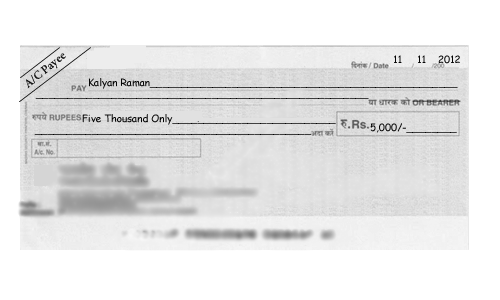
Suppose you are writing a Cheque to “KALYAN RAMAN” and you have left sufficient place in between “KALYAN” and “RAMAN” then anyone by adding “I” to the end of “KALYAN” can change it to “KALYANI RAMAN”.
To make sure that these things do not happen, you should write the name in such a way that no one can add an alphabet to make it something else. If you have the payee’s account number then to be more specific you can add that along with the payee name. Suppose KALYAN RAMAN has an account “00001” with ABC bank. Then in place of payee you can write “KALYAN RAMAN A/c No:00001”.
After writing payee’s name or payee’s name with account number add a line ______________________” next to it so that no one can add anything else to it.
The word Bearer
At the end of the payee’s name, you will find an option of bearer. When you want to make party payment by writing specifically the name or account number of the party then strike out this word “OR BEARER” other wise Cheque will be paid to either the party whose name written on it or the person who is holding it, it can be anyone.
Suppose you have issued a Cheque on which the word “or bearer” has not been strike out, in this case if I get the Cheque then I can take out the money from your account as I am the bearer of it at that moment.
Writing “A/c payee” in between two cross line in the top left hand corner of the Cheque in addition to payee’s name will ask the bank to make payment to the payee’s account only i.e. the person having a bank account can only take payments.
Cheque Amount
In a Cheque, you will have two places to write your amount that you want to pay. In the first place you write the amount in number and in the other place it should be in words. While writing in number you should put “/-” at the end of the amount so that it can not be tampered.
Adding “/-” at then end will send a message to the banker that it’s the end of the amount to be paid. If you want to add some paisa while paying in Cheque then you should put your paisa after the sign of “/” and should not put “-” at the end.
For example while making payment of Rs. 5,000 you should write is as “5,000/-”. If the payment of for Rs.5, 000.50 then you should write is as “5,000/50”.
By writing the amount in words you will let the bankers to double sure the amount that need to be paid to payee. Banks will Check both the amounts before making payment.
As discussed above, here also you should not leave any place in between to add a number or letter to the original amount. After writing the amount in number or words put a line “________________” at the end to make sure that no one can write anything after your have written the amount.
Signature
Sign the Cheque with your signature that you have used while opening your bank account. If you are an authorised signatory for your company or firm then use your seal in addition to your signature. If you have done any mistake while writing the Cheque then below the mistake or above it you have to put your signature.
Normally account holder’s name and account number are printed on the Cheque leaf. However if it is not mentioned then make sure that you write you name under your signature in block capital letter within bracket and in place of “A/c No:” write down your correct account number.
Cheque Date
As per RBI guidelines, Cheque that has been issued today will be valid for next 3 months after which it will not work. If you do not write date on your Cheque then the payee can fill it up at his convenience and deposit it to the bank for getting paid. That time if you do not have sufficient fund in your account then the Cheque will get bounced and you have to face legal consequences for it.
If your payee asked for a post dated Cheque then make sure that you hold sufficient fund from the Cheque’s date to the end of 3 months from that date.
We also suggest you to write down the Cheque number, payee name, date of payment and amount paid in a safe place for your future reference. Banks are also providing you additional record sheets to write down this information. You can use those sheets or can have a place to write down your own information.
ICICI Bank has a very good training tutorial on writing Cheque. Have a look at it.
