When starting a business in India, one of the first and most important registrations you must complete is obtaining a PAN (Permanent Account Number).
PAN is essentially your financial identity with the Indian government and acts like a “passport” for all tax and financial activities. For beginners, understanding PAN is crucial because without it, many basic business operations—from opening a bank account to registering for GST—cannot be completed.
In this guide, you will learn what PAN is, why it matters for businesses, who needs it, and how to apply for it in India.
Key Takeaways
- PAN (Permanent Account Number) is a 10-character tax ID issued in India by the Income Tax Department.
- PAN is mandatory for almost all businesses in India to comply with tax and banking rules.
- Without PAN, TDS may be deducted at a higher rate and GST registration cannot be completed.
- PAN links all tax-related activities like income tax filing, TDS, and financial transactions.
- Both online and offline applications are available, and PAN must be linked with Aadhaar.
What is PAN?
PAN stands for Permanent Account Number. PAN is a 10-character alphanumeric code issued by the Income Tax Department of India. It looks like this: ABCPM1234F.
Think of PAN as a unique ID for all financial and tax-related activities. Just like your Aadhaar identifies you for government services, PAN identifies you in the financial and taxation world.
Why PAN is Mandatory for Businesses in India
PAN is mandatory for almost all types of business entities in India, including companies, LLPs, partnerships, and many proprietors. It serves multiple purposes:
- Tax compliance: Helps the Income Tax Department in tracking your business’s financial transactions.
- Banking: Required to open business accounts in a bank.
- Licensing: Necessary for GST, FSSAI, IEC, and other business licenses.
- High-value transactions: Mandatory when buying property, shares, or entering transactions above certain limits.
- Avoid higher TDS: Without PAN, tax may be deducted at a higher rate i.e. 20%.
For businesses, PAN acts like a financial passport for all future compliance and legal transactions.
How PAN Works (Step by Step)
- Application: Apply online through the Income Tax e-Filing portal, NSDL, or UTIITSL. Alternatively, Indian residents can apply offline using Form 49A.
- Document Submission: Submit proof of identity, address, and date of birth. Aadhaar is the most commonly used document. For instant e-PAN, ensure your Aadhaar is linked to a mobile number.
- Verification: The Income Tax Department verifies the details provided in your application.
- PAN Allotment: A digital copy (e-PAN) is usually issued within 48 hours. You can download the e-PAN from the Instant PAN section of the e-Filing portal. A physical PAN card is optional. You can apply for printed PAN card by paying a fee. At present, for dispatch of PAN card within India, charges are Rs 50.00 (inclusive of taxes). If its for dispatch of PAN card outside India, charges are Rs 959.00 (inclusive of taxes).
- Usage: Businesses link PAN to:
- Income tax returns
- TDS/TCS reporting
- Specified financial transactions
- GST registration
- Loan and banking compliance
Who Must Obtain a PAN?
PAN is mandatory for:
- Every person or entity earning taxable income
- Businesses with turnover exceeding ₹5 lakh per year
- Companies, LLPs, and firms at the time of incorporation or after registration
- Foreign companies receiving payments from India
- Non-individual residents entering transactions above ₹2,50,000
Even if you don’t earn taxable income, many financial transactions in India require quoting PAN.
Without PAN:
- TDS may be cut at 20% or more (Section 206AA)
- GST registration is not possible
- Certain foreign transactions may be blocked
Example: TDS without PAN (Section 206AA)
- Payment to Vendor: ₹2,00,000 for services
- Normal TDS (10%): ₹20,000
- TDS without PAN (20%): ₹40,000
- Impact: Vendor faces an additional deduction of ₹20,000 due to non-availability of PAN
Understanding PAN Structure
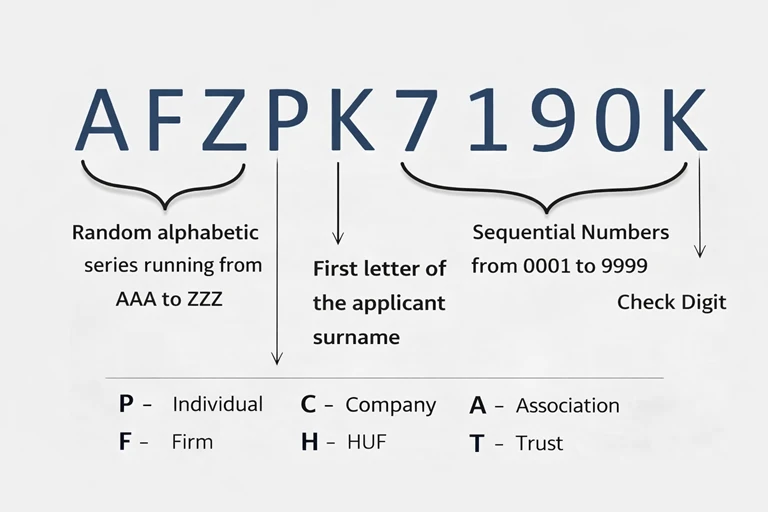
Understanding the structure of the ten characters of PAN helps you read a PAN correctly and avoid confusion in forms, tax filings, and bank documents.
A PAN always has 10 characters. These include letters and numbers, arranged in a fixed order.
The format looks like this: AFZPK7190K
PAN has 10 characters with this structure:
- 1–5: Alphabetic code indicating type of holder + random letters
- 6–9: Numeric sequence
- 10: Alphabetic check digit
Each position has a specific role. Let us go step by step.
First Three Characters: Alphabetic Series
The first three characters are always letters.
They run in an alphabetic series from AAA to ZZZ.
These letters do not tell you anything personal about the PAN holder.
This series helps the department generate unique PAN numbers. It is mainly for internal tracking.
Example: If the PAN starts with BLG, it simply means it falls somewhere between AAA and ZZZ in the series. In practice, many beginners try to find meaning in these letters, but there is none related to name or income.
Fourth Character: Status of the PAN Holder
The fourth character is very important. It shows who the PAN belongs to.
Here is what each letter means:
- P – Individual
- C – Company
- H – Hindu Undivided Family (HUF)
- A – Association of Persons (AOP)
- B – Body of Individuals (BOI)
- G – Government Agency
- J – Artificial Juridical Person
- L – Local Authority
- F – Firm / Limited Liability Partnership
- T – Trust
This character tells the tax system whether the PAN is for a person, business, or organisation.
📍 Common confusion: Many people think PAN is only for individuals. In reality, companies, firms, trusts, and even government bodies have PANs.
Fifth Character: Name or Surname Initial
The fifth character is also a letter.
For individuals, it is the first letter of the surname. For non-individuals, it is the first letter of the entity’s name.
This links the PAN visually to the name of the holder.
Example:
If an individual’s surname is Sharma, the fifth character will be S.
If a company is named ABC Traders Private Limited, the fifth character will be A.
Sixth to Ninth Characters: Sequential Numbers
The next four characters are numbers. They run from 0001 to 9999.
These numbers make each PAN unique, even if names and categories are similar.
Two individuals with the same surname can still have different PANs because these numbers will differ.
Tenth Character: Alphabetic Check Digit
The last character is a letter, called a check digit. It is used to validate the PAN and reduce errors.
If a PAN is typed incorrectly, this character helps systems detect the mistake.
In everyday use, you do not need to understand how it is calculated.
Complete Example of a PAN
Illustrative PAN: AFKPT6789M
- AFK – Alphabetic series (runs from AAA to ZZZ)
- P – Individual
- T – Surname starts with T
- 6789 – Sequential numbers
- M – Alphabetic check digit
PAN is a structured identification number, not a random code.
Each of the ten characters has a fixed role—from identifying the type of holder to ensuring accuracy.
For beginners, understanding the structure of PAN builds confidence while filling tax forms, bank KYC, and financial applications.
How to Apply for PAN in India
Online Application
- Visit Income Tax E-filing portal or NSDL or UTIITSL portal
- Choose Form 49A (for Indian individuals)
- Upload required documents
- Pay the fee online
- Send physical documents if requested
- Receive e-PAN
Offline Application
- Fill Form 49A
- Attach ID, address proofs, and photos
- Submit at PAN centre
- Receive PAN after processing
ℹ️ Special Rule: As per Section 139AA, link PAN with Aadhaar. PAN not linked with Aadhaar may become invalid.
Common Mistakes & Quick Tips
- Do not apply for multiple PANs — it is illegal.
- Ensure the name in Aadhaar and PAN application matches exactly.
- Keep your registered mobile number active for OTP verification.
✨ Companies do not need to apply separately for a PAN. A Permanent Account Number (PAN) is automatically allotted at the time of company registration with the Registrar of Companies (RoC). This ensures that every registered company has a PAN from the outset, eliminating the need for a separate application process.
Conclusion
PAN is the foundation of all business and financial operations in India. It acts as a unique identity for tax and banking purposes and is required for almost every high-value transaction. By understanding PAN, its structure, and application process, beginners can ensure smooth business compliance and avoid unnecessary tax issues.
