Bearish and bullish piercing candlestick patterns are considered as a signal for trend reversal. In a downtrend, a bullish piercing pattern (also called simply the Piercing Pattern) signals a trend reversal to the upside. Similarly, in an uptrend, a bearish piercing candlestick pattern signals a trend reversal to the downside.
The Bearish piercing pattern is known as the Dark Cloud Cover candlestick pattern.
In our earlier articles we have discussed single candlestick patterns such as Hammer, Shooting Star, Inverted Hammer and Hanging Man that signal reversal to the ongoing trend.
Bullish piercing candlestick pattern is a two candle reversal pattern considered as a potential signal for bullish reversal after a strong downtrend. Traders use price action to determine the downtrend.
What is Bullish Piercing Candlestick Pattern
In a bullish piercing pattern, the first candle is a long bearish candle, the second candle gaps open lower than the first candle, and it closes well above the midpoint of the 1st long bullish candle. For a better signal, look for more than 50% penetration of the first candle’s real body.
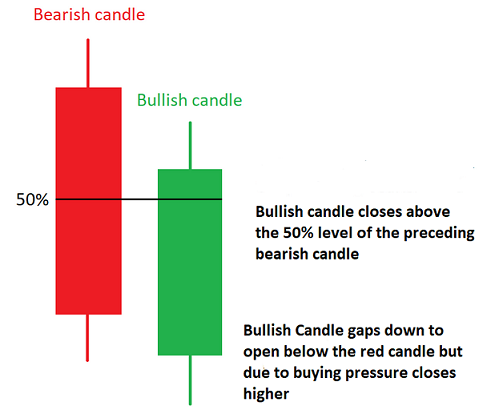
In a daily chart, Bullish piercing pattern indicates that the bearishness consists on the signal day as bears open the price lower than the previous day close, however, bulls fight back to push the price higher. This means on the signal day, the bullish candlestick opens with a gap down, but closes well within the trading range of the previous bearish candle.
Remember, the signal day high does not exceed the high of the previous bearish day to consider it as a bullish piercing pattern. If it crosses, it will be treated as a bullish engulfing pattern. Both are considered as bullish reversal candlestick patterns.
Rule of recognition
Here are the conditions to be satisfied;
- Downtrend must be in progress.
- This double-stick pattern should consist of a bearish candle and a bullish candle.
- The open of the bullish candle (signal day) should be lower than the low of the bearish candle (setup day).
- The second candle must have a gap down opening, giving the impression of a very weak market, but bulls counterattack to close the bullish candle much higher than the open,which is also much higher than the close of the previous bearish candle, most preferably at or above the midpoint of the first day’s bearish candle’s real body.
When the second condition is satisfied, it signals that the bearishness persists at the beginning due to more selling pressure. When the setup candle closes much higher than the open, it indicates that the bulls came in a reaction to the lower opening price and pushes the price higher.
Since the piercing pattern indicates that bulls were unable to completely reverse the losses of the previous candle, more bullish movement is expected before entering long. In comparison to the bullish piercing candlestick pattern, the bullish engulfing pattern is considered as being more bullish as it completely reverses the losses of the 1st candle.
Before entering a long trade, market participants require further confirmation as reliance on this pattern alone is not recommended. To obtain confirmation they may use RSI, MACD, Stochastic, volume, support and resistance.
For further study, the bearish equivalent of the piercing candlestick pattern is the Dark Cloud Cover.
Here is a list of candlestick patterns for your reference;
- Evening Star
- Morning Star
- Bearish Abandoned baby candlestick pattern
- Bullish Abandoned baby candlestick pattern
- Three Inside up/down
- Three outside up/down
- Inside Bar
- Dark Cloud Cover
- Spinning Top
- Shooting Star and Inverted Hammer
- Hammer & Hanging Man
- Gravestone, Dragonfly and long-legged Doji
- Engulfing Candlestick Pattern
- Spinning Top
- Marubozu
Be sure you practice identifying and trading these candlestick patterns on a demo account before trading them with real money.
In addition to the disclaimer below, please note, this article is not intended to provide investing or trading advice. Trading in the stock market and in other securities entails varying degrees of risk, and can result in loss of capital. Most investors and traders lose money. Readers seeking to engage in trading and/or investing should seek out extensive education on the topic and help of professionals.
