One of the most common technical tools used to track the movement of stocks or securities are the candlestick patterns. Shooting star, hammer, hanging man and inverted hammer candlestick patterns spotted after a sharp rally or decline, can be considered as the most important pattern for trend reversal.
These single candlestick patterns can help you a lot to spot a trend reversal within the market context.
In our last article, we discussed hammer and hanging man candlestick patterns. In this article, we will tell you about Shooting Star and Inverted Hammer candlestick patterns. You will also know why and when these reversal candlestick patterns are important.
Shooting Star Candlestick Pattern
If a small real body has a long top wick in comparison to a no or very small bottom wick, it means the buyers failed to push the price higher. These types of candles are called Shooting stars. It indicates that the buyers are losing control and that the seller may take over.
Shooting star as shown below is a bearish candlestick pattern that appears after an uptrend with a long upper shadow, little or no lower shadow, and a small real body at/or near the bottom.
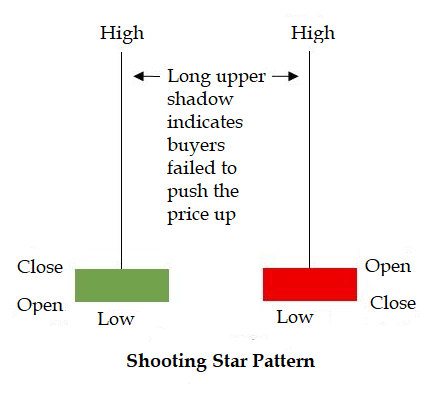
In general the Shooting Star Pattern is formed when the market has rallied for a period.
If a shooting star is formed in a bullish trend, it suggests that the bulls have become exhausted and the bears are fighting back to take control. It indicates after a price advance, the price could start falling.
Rules of recognition
Here are the features of Shooting star pattern in a daily chart;
- The setup day is a long bullish candle, which is printed as a continuation of an uptrend.
- The next day starts with a gap up opening and continues moving higher when more bulls participate. At some point of time, the bears take control and selling begins. Such bearish action pushes prices down below the candle’s opening price to close at a low level.
Shooting star is the second candle of the pattern as the first candle must be a bullish candle as a continuation of the uptrend.
Instead of getting a shooting star, you may get a doji, to indicate similar trend reversal. Such a pattern is known as bearish doji star. The doji pattern always indicates that the battle between bulls and bears was a tight one. When a bullish doji star appears in an uptrend, it means that the bears are about to seize control.
In general, we have three types of doji. A gravestone doji is a type of shooting star pattern that has no real body, where open and close are almost the same. All dojis indicate indecision and possible reversal of the trend.
Traders generally wait to see how the next candle following a shooting star is formed. If prices decline, they might sell or short.
Instead, if price rises after a shooting star formation, they consider it as a false signal or the candle is making a potential resistance area around the price range of the shooting star candle.
Psychology behind shooting star formation
Shooting star formation at the top of an uptrend indicates a potential price drop or reversal. It’s considered as most effective when it forms after a series of bullish candles in an uptrend.
Following an uptrend, a bullish candle is formed showing continuation of buying pressure over the last several sessions. As time progresses, the seller steps in and pushes the price back down to near the open, erasing the gains for the period of the candle forming a shooting star candle. This shows that buyers lost control by the close of the candle, and the sellers may take over.
As price drops back to the price where it opened, the upper shadow of the shooting star indicates that buyers who bought during that period of the candle are now in a losing position, if they haven’t squared off their position.
The candle that forms after the shooting star is considered as a confirmation of selling pressure. If this candle gaps lower or open near the close of the shooting star and then moves lower with heavy volume, it helps as a confirmation of price reversal to indicate that price might continue to fall. Looking at these kinds of candlestick reversal patterns, many traders will jump in to sell or short.
In case price rises after forming a shooting star candle, then it might create a range or price may consolidate in the area of the shooting star. Instead if price continues to rise, traders may consider the uptrend is still intact to go long.
If you see a shooting star candlestick pattern in a daily time frame, it indicates bearish formation for the day because price tried to rise significantly during the day, however sellers stepped in and took control to push the price back down towards the open. The candle that forms after the shooting star is what confirms the pattern. A bearish candle after a shooting star helps confirm the price reversal and indicates the price could continue to fall. If a follow up bearish candle is formed, traders may look to go short or sell.
Instead if price rises after shooting star formation, the pattern might be a false signal or price might have faced temporary resistance around that price level. The price range of the shooting star may act as resistance due to which the price might consolidate around the range of the shooting star candle.
Inverted Hammer Candlestick Pattern
Inverted hammer is a single candle similar to a shooting star with a long upper shadow and a small real body. The only difference from a shooting star candle is that it is technically considered as an inverted hammer when a downtrend is in progress. It’s considered as a bottom reversal pattern. Longer the shadow, more weightage is given to the pattern.
All other characteristics of a shooting star are applicable to the inverted hammer with the exception of the trend in progress.
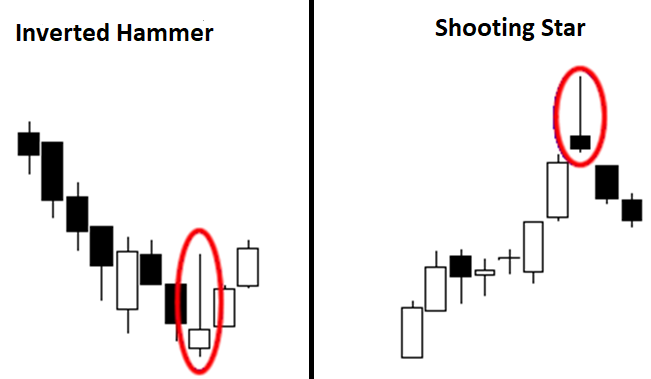
Candles shown in white color are bullish candles and those colored black are bearish candles.
Summary
- Shooting stars indicate a potential top and reversal. It’s a bearish reversal candlestick. This shows that buyers lost control and the sellers may take over. The long upper shadow represents the buyers holding their position by the close of the candle are now in a losing position because the price dropped back to the open.
- Inverted hammer is a bullish reversal candlestick pattern that looks like a shooting star but formed in a downtrend. It looks like an upside down version of the hammer candlestick pattern. This shows that sellers lost control and the buyers may take over.
- The shooting star and inverted hammer candlestick pattern looks exactly the same, this means they both have long upper shadows and a small real body at the bottom with little or no lower shadow. The main difference is where the pattern forms. If the pattern forms at the top of an uptrend, it’s called a shooting star. Instead, if the pattern forms at the bottom of a downtrend, it’s called an inverted hammer.
- One candle formation is not all that significant in a major up or down trend. This is why confirmation is required. If a shooting star is formed, selling must occur after it’s formation. If a hammer is formed buying must occur after its formation.
What is PIN Bar candlestick pattern
Many traders instead of remembering these types of patterns by its name, they refer to it as “Pin Bar”.
Inverted hammer, shooting star, hanging man and hammer candlestick patterns as discussed in our articles are called “Pin Bars” as they look like a pin.
This means, a bearish pin bar formed after an uptrend is referred to as either Hanging Man or shooting star based on how the pattern is formed.
A bullish Pin bar at the end of a bearish trend is either called Hammer or inverted hammer based on how it is formed.
Pin bar at the top or at the bottom of a trend is considered as a reversal pattern signaling that the previous trend has weakened.
Here are the rules of recognition for PIN Bars;
| Particulars | Hammer | Hanging Man | Shooting Star | Inverted Hammer |
|---|---|---|---|---|
| Trend in progress | Downtrend | Uptrend | Uptrend | Downtrend |
| Open and Close have a very tight range (small read body) | Yes | Yes | Yes | Yes |
| Shadow | The lower shadow must be at least twice the size of the body. Have very small or no upper shadow. | The lower shadow must be at least twice the size of the body. Have no or very short upper shadow. | The upper shadow must be at least twice the size of the body. | The Upper shadow must be at least twice the size of the real body. |
| Color of the body | Unimportant, but if it’s green, it shows more bullishness | Unimportant, but if it’s green, it shows more bearishness | Unimportant, but if it’s red it shows more bearishness | Unimportant, but if it’s green it shows bullishness. |
| Probability of reversal (Always take confirmation before taking any decision) | High, but depends how sharp the downtrend is. | High, but depends how sharp the uptrend is. | High, but depends how sharp the uptrend is. | High, but depends on how sharp the downtrend is. |
Traders use stop losses and different money management strategies while making trading decisions using candlesticks, so when they don’t work out their risk is controlled. They use candlesticks in conjunction with other indicators such as support, resistance and trend lines.
Here is a list of candlestick patterns for your reference;
- Evening Star
- Morning Star
- Bearish Abandoned baby candlestick pattern
- Bullish Abandoned baby candlestick pattern
- Three Inside up/down
- Three outside up/down
- Inside Bar
- Bullish Piercing
- Dark Cloud Cover
- Spinning Top
- Hammer & Hanging Man
- Gravestone, Dragonfly and long-legged Doji
- Engulfing Candlestick Pattern
- Spinning Top
- Marubozu
Be sure you practice identifying and trading these candlestick patterns on a demo account before trading them with real money.
In addition to the disclaimer below, please note, this article is not intended to provide investing or trading advice. Trading in the stock market and in other securities entails varying degrees of risk, and can result in loss of capital. Most investors and traders lose money. Readers seeking to engage in trading and/or investing should seek out extensive education on the topic and help of professionals.
